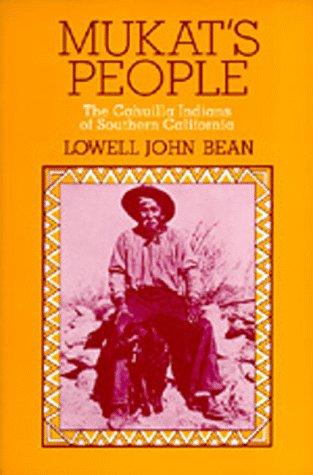
Mukat's People: The Cahuilla Indians of Southern California
by Lowell John Bean
1 copy available
About This Book
From the Introduction by Lowell J. Bean:An apparent dichotomy exists in scientific circles concerning the role of religion and belief systems and a similar dichotomy exists among anthropological theorists. Two assumptions seem to prevail: ritual and world view are more ecologically nonadaptive than adaptive; or ritual and world view are more ecologically adaptive than they are nonadaptive. To examine the relevancy of the opposing theoretical views I will develop hypotheses concerning a particular culture, the Cahuilla Indians of Southern California, which will be used as a test case. I will present two sets of hypotheses which logically follow from each of the assumptions. From the first assumption I suggest that the economic needs of society are impeded by ritual actions which are not only wasteful of productive goods but decrease the production of goods; they take people away from productive activities because of ritual obligations: and . from the second I suggest that the economic needs of society are impeded by normative and existential postulates (for definition see page 16o) which indicate that valuable resources are outside the realm of the economic order; these postulates are disruptive to the production of goods by encouraging people to behave in such a way that they are taken away from productive activity. From this latter viewpoint two other hypotheses follow: the ecoiwmic needs of society are facilitated by ritual action which conserves and increases the production of goods and fosters productive activity by directing personnel toward producing activities; and the economic needs of society are facilitated by normative and existential postulates which foster the use of valuable economic resources and increase the productive process by directing behavior which involves people in productive activities. The validity of the hypotheses will be tested by asking specific questions related to the hypotheses. The questions are:Were goods wasted because of ritual a